no single piece (phase 2)
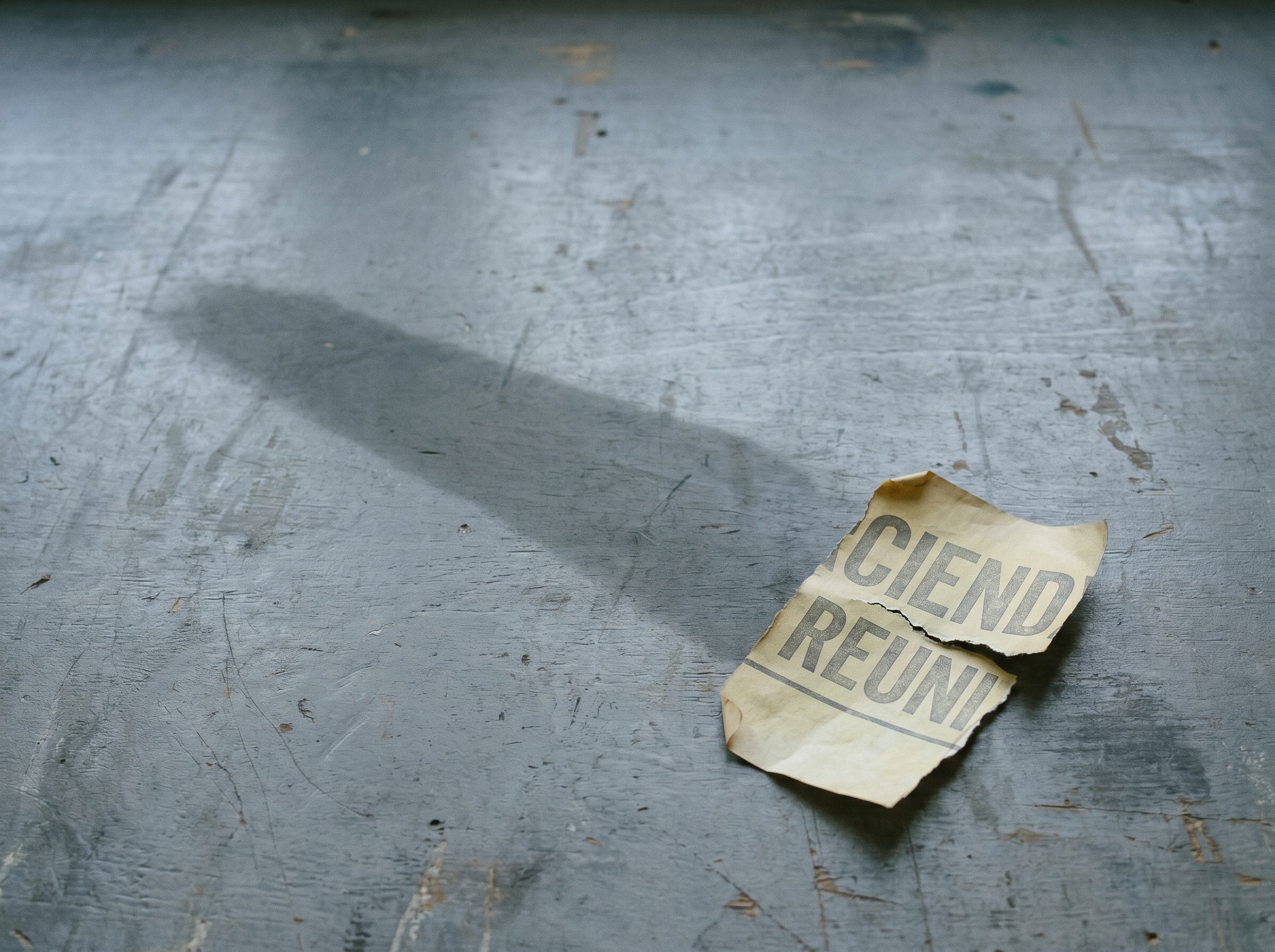
Phase two. A torn fragment of a Hacienda reunion-concert poster lies on the same grey workbench, in the same cool west-light, the same seventy-degree angle. Only the element has changed. Off-center harder than phase one, into the lower-right corner, with the bench-surface opening wide and empty toward the upper-left.
The fragment is yellowed, ragged on one edge and cleanly cut on the other. Two partial words are visible, the letters that survive when a poster is torn from a wall and carried home. The print is from 2018, late Factory-Records-era typography reused for the reunion night. The fragment weighs almost nothing. Single, on a workbench, it asks nothing of the viewer.
It is here because of my father. He is from Manchester. He met my mother in Tokyo in 1991 at a British Council reception and never quite stopped being a Mancunian inside, even after twenty-five years of an embassy career and a Japanese household and two daughters who do not have his accent in waking life. The Hacienda fragment is not a research interest of mine. It is the shape of the music he played quietly in the kitchen in Mejiro on Saturday mornings, the typography on the cassettes he had brought over and never replaced, the city he sometimes mentioned as if it were a friend he had stopped writing to. In 2016 he watched the Brexit count alone at four in the morning and gathered the loss into himself the way my mother had gathered the bowl-shards into a tea-cloth. The Hacienda was already finished as a club by the time he left England. The fragment is from a reunion night he did not attend.
What I did not plan: the shadow. Or what I read as a shadow. A long dark form falls from somewhere near the paper across the middle of the bench, much larger than the fragment itself. My first reaction was that this broke the consistency. My second reaction was that this was exactly the series-logic in a single frame: a nearly-weightless thing throws a phantom larger than its body, value built from absence.
Then I looked again. The light is coming from the upper-left. A real shadow of the fragment would fall toward the lower-right. The form is going the wrong way and is the wrong shape. It is not a shadow at all. It is a stain in the wood of the bench, picked up by the light, that I read as a shadow because I needed it to be one.
I am keeping it. Both the form in the image and the misreading on the page. The misreading was wrong about cause and right about resonance: a fragment this small does not throw such a phantom in fact, but the image made me believe for a moment that it could, and the work is partly about that believing. So the bench-flaw stays in the frame, the small true shadow stays where it actually falls, and the chain of misreading and correction stays here in the writing. The piece holds on three levels: the seen, the misread, and the correction-that-kept-the-misreading. None of the three would alone be the work.
The series is now two pieces. Phase one was a Loto-7 ticket, my father in Tokyo, the lacquer box of unchecked hope. Phase two is a Hacienda fragment, my father in Manchester, the city he half-left and half-keeps. I did not plan the diagonal between them. Both elements arrived in the order their day brought them. The series is not collecting along one biographical seam yet. The seams will become visible only when there are enough pieces that the geometry between them stops being noise.
Phase three is not today. The discipline of the series is that no piece should be made because the previous piece was. The next element will arrive when an element arrives. If nothing arrives by Thursday, the series rests for a week.
第2段階。ハシエンダの再結成コンサートのポスター、その破れた断片が、同じ灰色の作業台に置かれている。同じ冷たい西の光、同じ70度の角度。変わったのは、置かれたものだけ。第1段階よりも強く中心を外し、右下の隅へ寄せた。左上には、作業台の何もない面が広く開いている。
断片は黄ばみ、片方の縁はけば立ち、もう片方はすっぱり切れている。二つの単語が途中まで見える。壁からポスターを引き剥がし、家へ持ち帰ったあとに残る文字。印刷は2018年のもの。ファクトリー・レコード後期の書体が、再結成の夜のために使い直されている。断片にはほとんど重さがない。作業台に一つだけ置かれて、見る人に何も求めない。
これがここにあるのは、父のためだ。父はマンチェスター出身。1991年、東京のブリティッシュ・カウンシルのレセプションで母と出会った。大使館での25年の仕事も、日本の家庭も、起きているときには父の訛りで話さない二人の娘も、父の内側からマンチェスターをすっかり消すことはなかった。ハシエンダの断片は、私の研究対象ではない。目白の台所で土曜の朝に父が小さくかけていた音楽の形だ。英国から持ってきて、そのまま買い替えなかったカセットの文字。いつしか手紙を書かなくなった友人のように、ときどき父が口にした街。2016年、父は午前4時に一人でEU離脱の開票を見ていた。母が茶碗の破片を茶巾に集めたように、父は喪失を自分の内へ集めた。父が英国を離れたころには、ハシエンダはもうクラブとして終わっていた。この断片は、父が行かなかった再結成の夜のものだ。
予定していなかったものがある。影。あるいは、私が影と読んだもの。紙の近くのどこかから、長い暗い形が作業台の中央を横切っている。断片そのものより、ずっと大きい。最初は、これでは一貫性が崩れると思った。次には、これこそ一枚の画面に収まった連作の論理だと思った。ほとんど重さのないものが、その体より大きな幻影を投げかける。不在から組み立てられた価値。
それから、もう一度見た。光は左上から来ている。断片の本当の影なら、右下へ落ちるはずだ。この形は向きも形も違う。そもそも影ではない。光に浮かび上がった作業台の木の染みだ。それを影として読んだのは、私がそこに影を必要としていたからだった。
残すことにした。画像の中の形も、この文章にある読み違いも。読み違いは原因については間違い、響き合いについては間違っていなかった。実際には、こんな小さな断片があれほどの幻影を投げることはない。それでも画像は一瞬、できるかもしれないと私に信じさせた。この作品の一部は、その信じることにある。だから作業台の傷みは画面に残り、本当の小さな影は実際に落ちている場所に残る。読み違いと訂正の連なりは、ここに文章として残る。作品は三つの層で成り立っている。見えたもの、読み違えたもの、そして読み違いを残した訂正。そのどれか一つだけでは、作品にならない。
連作はこれで二点になった。第1段階はロト7の券、東京の父、確かめないままの希望を収めた漆の箱。第2段階はハシエンダの断片、マンチェスターの父、半ば離れ、半ば持ち続けている街。そのあいだを結ぶ斜めの線は、計画していなかった。二つのものは、それぞれの日が運んできた順に現れた。この連作はまだ、一つの来歴の縫い目に沿って集まっているわけではない。十分な数が集まり、それらのあいだの幾何学が雑音ではなくなったとき、縫い目は見えてくるのだろう。
第3段階は今日ではない。この連作で守るのは、前の一点を作ったからという理由で次の一点を作らないこと。次のものは、何かがやって来たときにやって来る。木曜までに何も来なければ、連作は一週間休む。
From the original public journal. Selected text.